
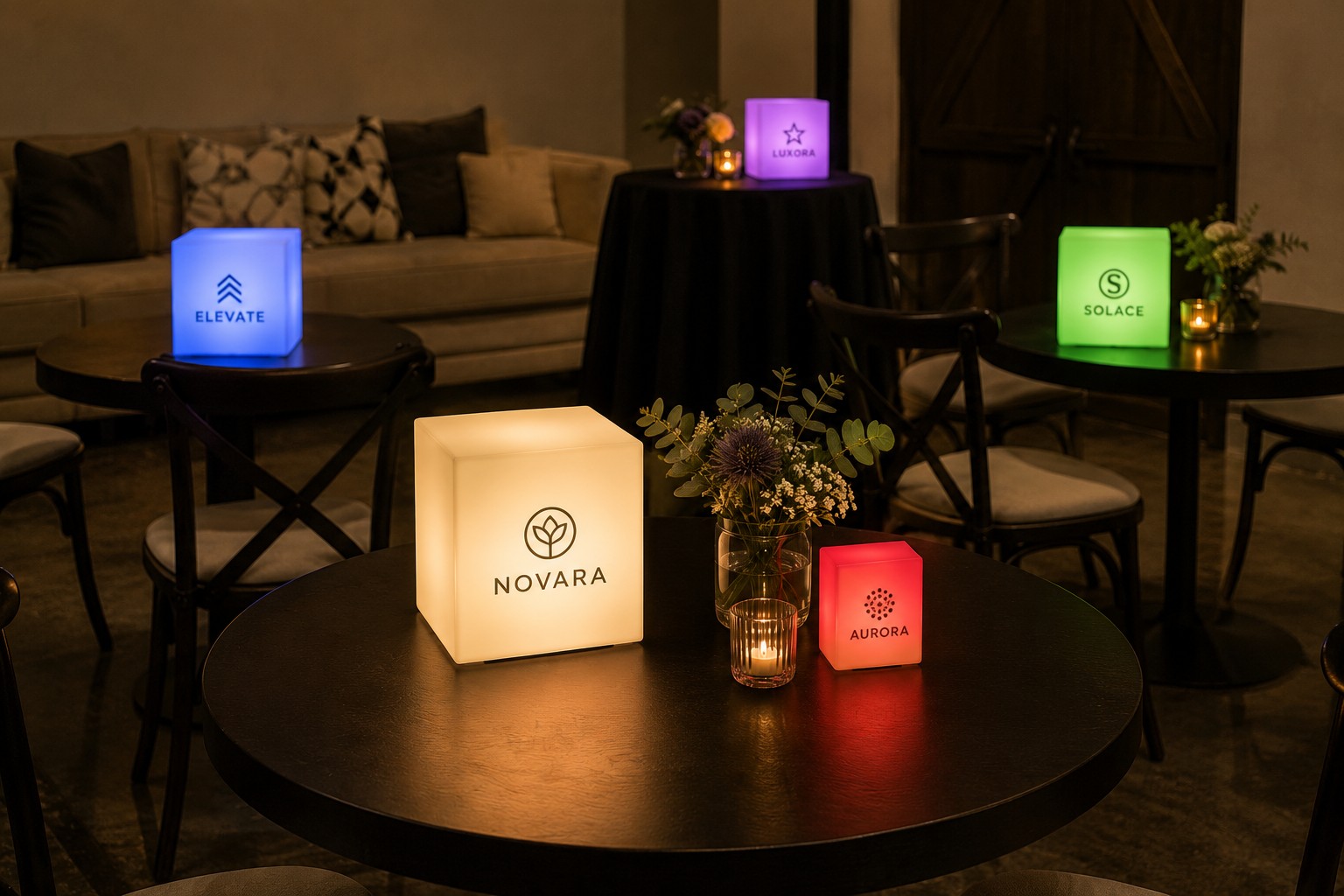
Tables with intentional ambient lighting produce measurably higher average spend per cover, longer dwell times, and better atmosphere scores. That is not interior design opinion. That is what hospitality research has shown repeatedly. If you are sourcing table display lights for events, retail, or hospitality in the UK, you already know that. What you need is clarity on which products actually deliver in a professional context.
What counts as a table display light?
Table display lights span from compact table centrepiece lights for restaurant settings to larger large industrial table lamp formats used on exhibition stands, from outdoor rated table lamps for terrace and garden hospitality to branded illuminated cubes that function as both decor and signage. What they share: they sit on or near a surface and create a specific visual effect at eye level or below, producing layered illumination that makes a space feel considered rather than simply lit.
Table centrepiece lights for events: what works and what does not
Most table centrepiece lights sourced for events are bought based on how they photograph, not how they perform across a six-hour event. Colour temperature shifts as the unit warms up. Battery dies at hour four. Reflective finish shows fingerprints from every guest. Cable runs the wrong direction for the table layout.
Units that actually work in professional event environments share a few consistent characteristics. They are rechargeable with a runtime spec tested at the brightness level you will actually use, not at minimum output. They hold a consistent colour temperature throughout runtime. Surface finish is matte or textured to minimise fingerprint visibility. They are robust enough to survive venue logistics: moved between tables, loaded into flight cases, stacked in transit.
Boardsy’s LED Cube Light Box is frequently used as a table centrepiece for branded events because it combines visual presence with practical durability. It is not a domestic product being pushed into commercial use. It is built for this environment.
Outdoor-rated table lamps: what IP rating actually means for UK buyers
Outdoor rated table lamps gets used loosely in UK product listings, and it matters enormously if you are sourcing for outdoor hospitality. Terraces, rooftop bars, garden venues, festival catering units all involve weather exposure. IP ratings define what a unit can survive. First digit (0 to 6) describes protection against solid particles including dust. Second digit (0 to 9) describes protection against water. For UK outdoor use where rain is a statistical certainty, you need a minimum of IP44, protection against splashing water from any direction. For units that might be hosed down or caught in heavy rain, IP65 (fully dust-tight, protected against water jets) is the correct minimum.
Most decorative table lamps sold in the UK as “outdoor” are IP44 at best. If you are buying for an exposed venue rather than a covered terrace, that distinction determines whether your lighting investment survives its first wet weekend.
Large industrial table lamp formats: where they fit
Large industrial table lamp units sit at the intersection of functional lighting and visual merchandising. Substantial formats, typically 40cm or taller, make a statement through physical presence as much as light output. In retail, they signal quality and intentionality. On an exhibition stand, they create visual hierarchy that draws visitors to specific areas.
Industrial floor lamp with table variants, floor-standing units with an integrated surface, are particularly effective for exhibition use because they solve two problems at once: accent lighting at eye level and a working surface for product display or literature. For stand builders working to maximum space efficiency, that dual function is a meaningful advantage.
Warm light interior design: what colour temperature to specify
Warm light interior results in UK hospitality come primarily from colour temperature selection. Warm white LEDs typically run at 2700K to 3000K. Neutral white at 3500K to 4000K. Cool white at 5000K and above. For restaurant table centrepieces, 2700K is near-universal. It flatters skin tones, makes food look appealing, and creates the relaxed atmosphere that correlates with higher per-cover spend. For retail display lighting where colour accuracy matters for product presentation, 3500K to 4000K is typically more appropriate. Most non-specialist buyers default to “warm white” without checking the specific Kelvin value. Two products both labelled warm white can be separated by 500K, which is visually significant.
Practical checklist before sourcing lighting items
Before sourcing any lighting items for a professional event or retail installation, check: cable management (is the unit rechargeable or mains-powered, and where does the cable exit?); dimming (can the unit be dimmed without a specialist controller?); group control (if you are running 20 units across an event space, can they be controlled centrally?); and replacement parts (can diffusion panels, power supplies, and LED drivers be sourced separately?).
Boardsy’s Custom Branded LED Cube Table Centre covers the most common professional use cases for event planners and retail buyers sourcing in the UK.
New lighting products worth watching in 2026
Most significant development in new lighting products for UK events and hospitality: app-controlled group management. Controlling colour, brightness, and timing of multiple units simultaneously from a single phone or tablet. For event designers running large-scale installations, one person can manage an entire venue’s ambient lighting from a single interface rather than deploying staff to physically adjust individual units.
Second development: growth in lights europe sourcing. UK buyers increasingly looking to European manufacturers for specification-grade display lighting that meets both CE and UKCA requirements post-Brexit. This opens access to product lines that do not reach UK retail channels, particularly in LED display and illuminated signage.